LOJEL Cubo Review: One Design Decision and Everything It Causes
On This Page
- The Idea and Its Consequences
- Consequence One: The Shell Scratches
- Consequence Two: The Laptop Floats
- Consequence Three: No Bottom Handle
- What It Holds and What It Costs
- The Lite Is Not Better Value
- The Expansion, and Its Catch
- The Measured Specification
- One Listing Oddity
- The Warranty
- Final Verdict
- FAQs
- How much is the LOJEL Cubo?
- What is the difference between Cubo and Cubo Lite?
- Does it fit as a carry-on?
- Does it scratch?
- Is there a laptop compartment?
- What is the warranty?
Most suitcases are a list of features. This one is a single idea with consequences, so this LOJEL Cubo review follows the idea outward rather than down a spec sheet.
The idea is that it opens from the front while standing up. Everything good and everything annoying about this bag comes from that.
The Idea and Its Consequences
The one idea | What follows from it |
|---|---|
A magnetic trapdoor on the front | No floor space needed |
So you open it standing up | Good for small hotel rooms |
So the shell must stay rigid | Polycarbonate, which scratches |
So the tech area sits in front | But has no laptop sleeve |
So the bottom is a closed panel | No bottom grab handle |
Front access solves one problem and creates four smaller ones.
A normal hard suitcase is a clamshell. You lay it flat, open it like a book and it occupies most of a small hotel room floor.
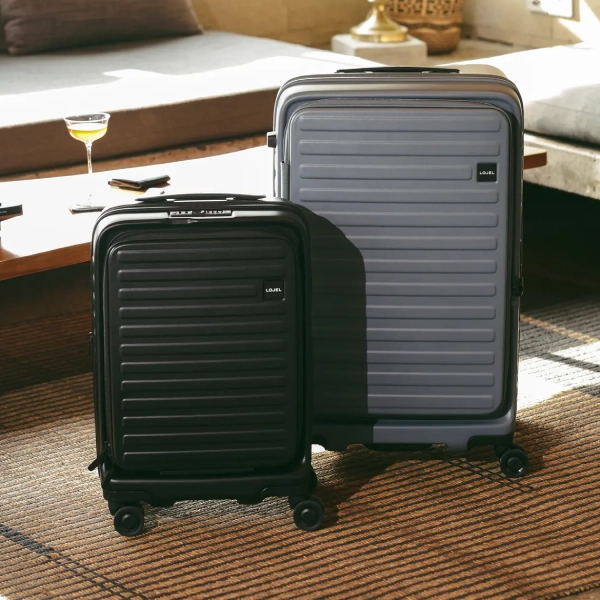
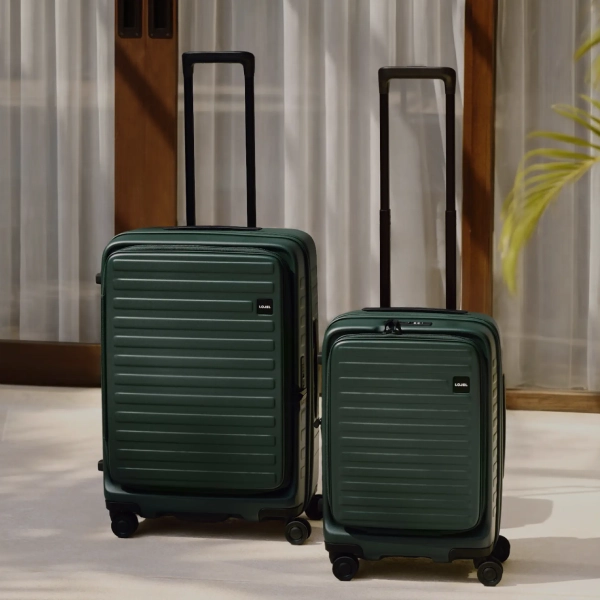
This one has a magnetic trapdoor on the front panel. You stand it up, drop the hatch and reach in. An independent tester called that reach into the main compartment the single best thing about the bag, and if you have ever packed in a room where the bed touches three walls, you already understand why.
Consequence One: The Shell Scratches
Front access needs a rigid panel that holds its shape, which means polycarbonate, and polycarbonate marks.
The tester found two or three visible scratches on a Stone Blue sample after two weeks and expected more over time. They were fair about it, noting this is not unique to this bag, and polycarbonate luggage across the industry behaves the same way.
The shell is 50% recycled and 50% new polycarbonate, with polyester and thermoplastic elastomer elsewhere. Naming the recycled proportion is more detail than most luggage brands publish, and we will credit it.
If you want a case that still looks new after a year of airline handling, no polycarbonate suitcase at any price will do that, this one included.
Consequence Two: The Laptop Floats
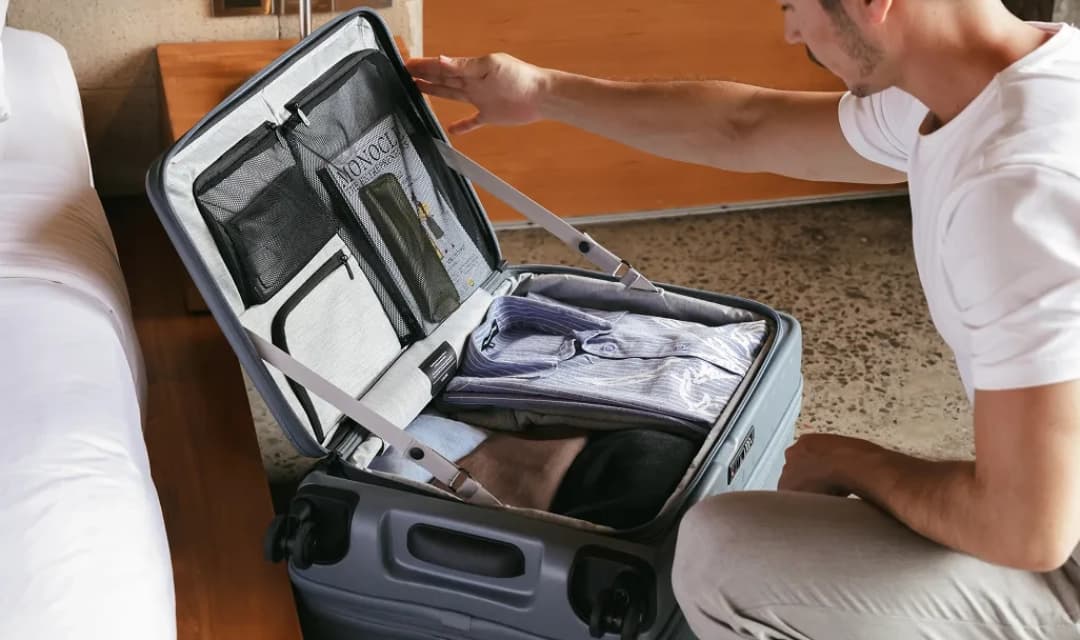
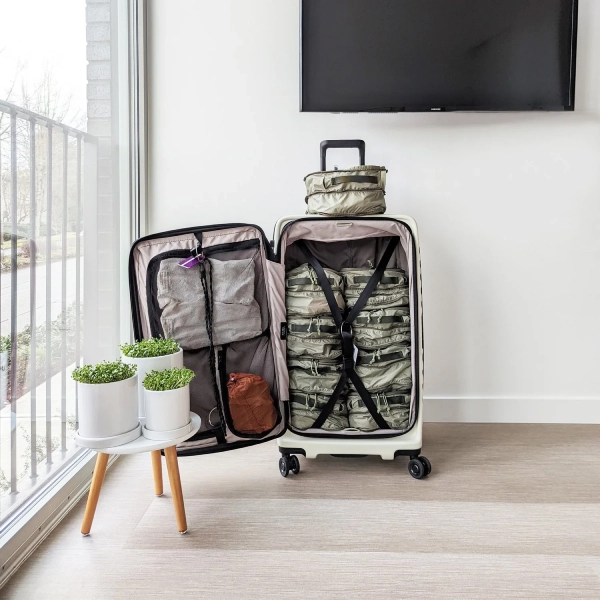
The trapdoor leads to a tech area with side gussets, back mesh pockets and a front zip pocket. What it does not have is a padded laptop sleeve.
The tester used a separate sleeve for a 13 inch MacBook and reported that a bare 16 inch MacBook Pro fits, though a padded sleeve or thick case may not.
That is a genuine design gap. A compartment explicitly built for tech, on a bag whose whole purpose is front access to your things, should hold a laptop properly, and this one leaves it loose unless you bring your own sleeve.
Consequence Three: No Bottom Handle
Lifting a case into an overhead bin usually means grabbing the bottom. Here the bottom has moulded indents rather than a handle, and the tester said plainly that those do not fully substitute.
Top and side grab handles are unpadded hard plastic, fine for stairs or a bin lift and unpleasant for a long carry. Four feet near the side handle stop the shell scraping when you set it down.
The telescoping handle runs to 40.2 inches across three settings plus fully retracted, extends smoothly and was described as conventional, with settings close enough together that the tester preferred the middle one.
What It Holds and What It Costs
Model | Price | Capacity | Weight |
|---|---|---|---|
Cubo Small Lite | $280 | 29 to 35L | 2.9 kg |
Cubo Small | $306 | 37 to 42L | 3.4 kg |
Cubo Medium | $357 | Not stated | Not stated |
Cubo Fit Lite | $374 | Not stated | Not stated |
Cubo Fit | $382 | Not stated | Not stated |
Cubo Large | $408 | Not stated | Not stated |
Six models from $280 to $408, a spread of 45.7%.
Prices in this LOJEL Cubo review run from $280 for the Small Lite to $408 for the Large.
One thing to flag before you compare them. The brand publishes full capacity and weight figures for the two carry-on models and, on the pages we read, no capacity, weight or dimensions at all for the four check-in models. On a suitcase, capacity is the specification, so that is an odd omission.
The Lite Is Not Better Value
Cost per litre, carry-ons | Figure |
|---|---|
Small Lite unexpanded, 29L | $9.66 |
Small unexpanded, 37L | $8.27 |
The Lite is dearer per litre by | 16.7% |
Small Lite expanded, 35L | $8.00 |
Small expanded, 42L | $7.29 |
Conclusion | Lite means smaller, not better value |
$9.66 a litre against $8.27, so the smaller bag costs more per litre.
This is the arithmetic that should decide which carry-on you pick, and nobody publishes it.
The Small Lite is $280 for 29L unexpanded, which is $9.66 a litre. The Small is $306 for 37L, which is $8.27 a litre. So the cheaper bag is 16.7% more expensive per litre of space.
Capacity per kilogram is almost identical too, at 12.07 litres per kg for the Lite and 12.35 for the Small. The Lite is not a more efficient design, it is simply a smaller bag that costs $26 less.
Buy the Lite because 29L suits how you travel and you want the removable front compartment, not because it looks like the value option.
The Expansion, and Its Catch
The expansion | Figure |
|---|---|
Small Lite | 29L to 35L |
That gain is | 20.7% |
Small | 37L to 42L |
That gain is | 13.5% |
The catch | Expanding can break carry-on size |
Up to 20.7% more space, which can push you past carry-on limits.
The Small Lite expands from 29L to 35L, a gain of 20.7%. The Small goes 37L to 42L, a gain of 13.5%.
The tester liked having the room for souvenirs but flagged two things. Expanding softens the middle of the case with an accordion effect, and it increases the bag's dimensions enough to affect carry-on compliance.
That is the honest catch. The expansion is for the flight home, when you can check the bag or accept the gate risk, not for outbound travel where you are relying on it fitting the sizer.
Buy the Small over the Lite unless 29L genuinely suits you
Bring your own padded laptop sleeve
Treat the expansion as a return journey feature
Ask for check-in capacities before ordering those models
The Measured Specification
Cubo Small, as tested | Figure |
|---|---|
Dimensions | 20.9 x 14 x 9.8 in |
Weight | 7.5 lb / 3.4 kg |
Shell | Polycarbonate, 50% recycled |
Other materials | Polyester and TPE |
Handle height | 40.2 in, three settings |
Wheels | Four paired, non hydrolyzing |
20.9 by 14 by 9.8 inches and 7.5 lb for the Small.
The Small measures 20.9 by 14 by 9.8 inches and weighs 7.5 lb, or 3.4 kg, which is mid pack for a hard carry-on rather than especially light.
Wheels are four paired sets of non hydrolyzing elastomer that roll laterally in any direction. The tester found them smooth on most surfaces and unbothered by gravel, with rocky ground overwhelming the rubber lining.
The liner is removable for cleaning, which is unusual and genuinely useful on a bag you will own for years.
One Listing Oddity
A listing oddity we could not resolve | Detail |
|---|---|
Cubo Fit Lite | $374 |
Cubo Fit | $382 |
Difference | $8, or 2.1% |
Stated differences on the page | None beyond price |
Specs published for check-in models | None we could find |
Two models, $8 apart, with no stated difference between them.
While reading the range we found something we could not resolve and would rather report than ignore.
The Cubo Fit Lite is listed at $374 and the Cubo Fit at $382, a difference of $8 or 2.1%, and the page we read states no difference between them other than price. With no published specifications for either, a buyer has nothing to choose on.
It is very likely there is a real difference in weight or capacity that simply is not on that page. Ask before you order.
The Warranty
The Cubo line carries a stated ten year warranty. The tester noted that registering the serial number through the built in QR code makes a claim easier but is not required for the warranty to be valid, which is a fairer arrangement than brands that make registration a condition.
One small disappointment the tester raised. That QR code goes to customer support rather than acting as a luggage identification tag, which would have been the more obviously useful feature.
Final Verdict
Category | Score |
|---|---|
The Front Access Idea | 9.5 / 10 |
Build And Materials | 8 / 10 |
Scratch Resistance | 5 / 10 |
Organisation And Laptop | 6 / 10 |
Value Per Litre | 6.5 / 10 |
Overall Score | 7.5 / 10 |
Seven and a half out of ten, matching the independent score of 7.9 closely. The front trapdoor is a genuinely good idea and it earns the price, backed by a ten year warranty, a removable liner, a 50% recycled polycarbonate shell and wheels that handled everything except rocky ground. The consequences of that idea are the cost: the shell picked up two or three scratches in two weeks, the tech compartment has no laptop sleeve, and there is no bottom grab handle. On value, buy the Small rather than the Small Lite, because the Lite costs 16.7% more per litre for the same packing efficiency, and treat the expansion as a feature for the journey home.
FAQs
How much is the LOJEL Cubo?
From $280 for the Small Lite to $408 for the Large, a spread of 45.7% across six models.
What is the difference between Cubo and Cubo Lite?
On the carry-ons, size and weight. The Lite is 29 to 35L at 2.9 kg and the Small is 37 to 42L at 3.4 kg, with packing efficiency per kilogram almost identical.
Does it fit as a carry-on?
The Small measures 20.9 by 14 by 9.8 inches unexpanded. Expanding it increases the dimensions enough to affect compliance, so check your airline's limits.
Does it scratch?
Yes. A tester found two or three visible scratches within two weeks on a Stone Blue sample, and noted this is normal for polycarbonate rather than specific to this bag.
Is there a laptop compartment?
There is a tech area but no dedicated padded sleeve. A bare 16 inch laptop fits, though a padded case may not, so bring your own sleeve.
What is the warranty?
The Cubo line is stated at ten years. Registering the serial number makes claims easier but is not required for validity.