
Peepers Reading Glasses Review: Why Nobody Buys One Pair

Reading glasses are the one optical product almost nobody buys singly. You need a pair by the bed, a pair at the desk and a pair in the bag, because the whole point of a cheap reader is that it lives where you need it rather than travelling with you.
Peepers has priced for exactly that behaviour, and the pricing is the most interesting thing on the site. So this Peepers reading glasses review starts with the per-pair arithmetic, because it changes what the brand costs by about a third.
The real price is not the price on the frame

A single frame on the product page we read listed at $32.00. The promotion running alongside it offered readers and sunglasses at 2 for $50, 3 for $69 and 4 for $88. Those are very different numbers.
Quantity | Total | Per pair | Vs single pair |
|---|---|---|---|
1 pair | $32.00 | $32.00 | - |
2 pairs | $50.00 | $25.00 | 21.9% less |
3 pairs | $69.00 | $23.00 | 28.1% less |
4 pairs | $88.00 | $22.00 | 31.2% less |
Four pairs bought one at a time would be $128. The four-pack is $88, so you keep $40, and the per-pair cost falls 31.2%. Even the step from a two-pack to a four-pack is a 12.0% drop per pair. That is a steeper curve than most eyewear brands run, and it means the honest way to compare Peepers against a pharmacy reader is not frame against frame. It is four of theirs against four of anybody else's.
One caveat, stated plainly. A bundle is only cheaper if you were going to buy four pairs. Buying four frames you half-like to reach a tier price is how people end up with a drawer of glasses they never wear. The tier works if you genuinely want readers in four places.
What the lenses actually say
The construction details on the product page we read were specific where it matters. The frame is polycarbonate, described as strong and lightweight. The lens is an acrylic aspheric material with a dual anti-scratch coating. UV400 protection is claimed, and the page puts a number on it, blocking 99.9% of UVA and UVB rays.
Then there is the blue light range. That is what a lot of people are shopping for.
The brand calls the technology Blue Light Focus and describes it as baked into the lens rather than applied as a surface coating. The help pages put the filtering range at 400 to 450 nanometres. What the pages did not give, anywhere we looked, is a filtration percentage.
That gap is worth noticing because the same brand is perfectly willing to publish a percentage when it has one. UV protection gets 99.9%. The blue light claim gets a wavelength range and no figure at all. A range tells you where a lens works and nothing about how much it removes there, and a lens that filters 5% of blue light and one that filters 40% can both honestly claim to filter the 400 to 450 nanometre band. So if that filtering is your reason for buying, ask the brand for the percentage in writing before you choose.
None of this makes the lenses bad. Baked-in filtering is generally more durable than a coating that can be polished off, and the independent evidence on blue light and sleep or eye strain is still an argument rather than a settled fact. But an unquantified claim stays unquantified.
Picking a lens strength

The collection tags on the page we read run from +1.00 to +3.00 in quarter steps, which is nine lens strength options. That covers the ordinary range for age-related close focus and stops short of the higher powers some people need.
The brand's own advice is to take the lower strength when you sit between two. That is sensible. Over-powered readers pull your working distance in closer than it should be, and that is a common reason a new pair feels tiring rather than helpful.
If you have never worn readers, start at the bottom of the range rather than guessing upward.
If one eye is noticeably different from the other, an off-the-shelf lens strength cannot correct that, and an eye test is the right step.
If you already have a prescription, match the reading addition rather than shopping by how a pair feels in the first thirty seconds.
If you are buying four pairs, consider buying them in one lens strength rather than hedging across two. Mixed strengths in a house is how you end up never knowing which pair you have picked up.
Returns, and the exception in them
The returns window on the page we read was 90 days from the order date, started through the site, with a refund to the original payment method, an exchange or store credit at your choice. Ninety days is generous for eyewear. It is long enough to find out whether a lens strength is right in real use rather than in a shop mirror.
One exception is worth reading before you buy a bargain. Closeout items qualify for exchange or store credit only, not a refund. So the cheapest frames carry the weakest return terms. That is a common structure, and still one to know about in advance.
No separate warranty statement appeared on the pages we read. For a $22 to $32 pair of acrylic-lensed readers that is unsurprising, but it does mean the 90-day window is the whole of your protection rather than the first part of it.
Where the range is strong and where it is thin
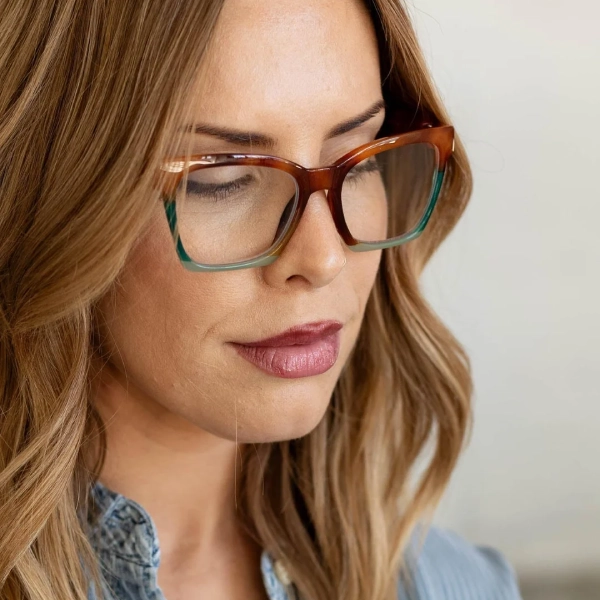
The strength of the brand is frame variety at a readers price. Most readers are either medical-looking or an afterthought at a till. A catalogue built around pattern and shape fills a real gap.
The thin part is specification detail. Frame measurements did not appear on the pages we read. That matters more for glasses than for most products, because a frame too wide slides down your nose and a frame too narrow pinches at the temple. If you already own a pair of glasses that fit, read the three numbers printed on the inside of the arm and ask the brand which frames match before ordering four of one shape.
The verdict
Priced as a single purchase, this is a $32 pair of polycarbonate-framed acrylic readers. Fair rather than cheap. Priced the way the site clearly wants you to buy, it is $22 a pair, and at that figure the frame variety becomes the reason to choose it over a pharmacy spinner rack.
The closing note of this Peepers reading glasses review is about the claim rather than the price. The UV number is published and specific. The blue light number is not published at all, so treat the blue light filtering as a feature you cannot yet compare and buy the glasses for the frames, the nine lens strength steps and the 90-day window instead. If the blue light performance is the deciding factor for you, get the percentage in writing first.