NapQueen Mattress Review: Buy the Big One
Budget mattresses get reviewed as though price were the only number. That is how a reviewer ends up calling a $168 bed good value without checking whether the $122 version of the same bed is better value or worse.
It is worse. Noticeably. That is the finding this NapQueen mattress review is built around, and it applies to almost every mattress brand once you do the division, but the gap here is wider than usual.
The price ladder, per square foot
A mattress is a rectangle of material. So the honest comparison between sizes is what you pay per square foot of sleeping surface, using the standard dimensions for each.
Size | Dimensions | Price | Square feet | Cost per sq ft |
|---|---|---|---|---|
Twin | 38 x 75 in | $122 | 19.79 | $6.16 |
Twin XL | 38 x 80 in | $138 | 21.11 | $6.54 |
Full | 54 x 75 in | $148 | 28.12 | $5.26 |
Queen | 60 x 80 in | $168 | 33.33 | $5.04 |
King | 76 x 80 in | $212 | 42.22 | $5.02 |
The Twin XL is the worst value in the range at $6.54 per square foot, and the Twin is close behind at $6.16. The Queen costs $5.04 and the King $5.02. So the Twin is 22.3% more expensive per square foot of mattress than the Queen, and the Twin XL is about 30% worse than the King. Buying the Twin XL rather than the Twin adds just five inches of length and $16, which works out at the single most expensive sixteen dollars in the catalogue. None of this is unique to one brand, because small sizes carry the same cutting, packing and shipping overhead across a smaller area. It does mean that if your room can take a Full rather than a Twin, the extra $26 buys 42.1% more sleeping surface.
The warranty, measured against the category
Both listings we read stated a 2 Years Limited Warranty. Two years.
A ten-year limited warranty is the ordinary term in the mattress market, including at budget prices. So two years is 80% shorter than the norm. A mattress is a five to ten year purchase for most households, which means this limited warranty expires somewhere around the first fifth of the product's expected life.
What a limited warranty usually covers is a manufacturing defect rather than ordinary softening, and sagging past a stated depth is the clause that matters in practice. Foam sag does not normally show up in year one. It shows up in years three to five, which on these terms is well outside the cover. So the two-year window is the opposite of reassuring, because it closes before the failure mode it would be needed for typically appears.
No sleep trial was stated on either listing we read. Buying through a retailer means you fall back on that retailer's general returns policy rather than a mattress-specific trial. A general returns window is usually measured in weeks. Check it at the point of purchase, because it is the only route back out of the decision.
What you are getting for the money
Credit where it is due. The specification at this price is not bad at all.
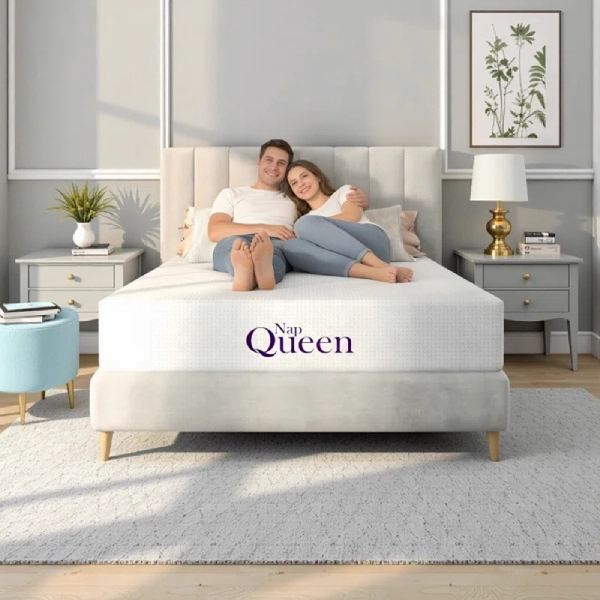
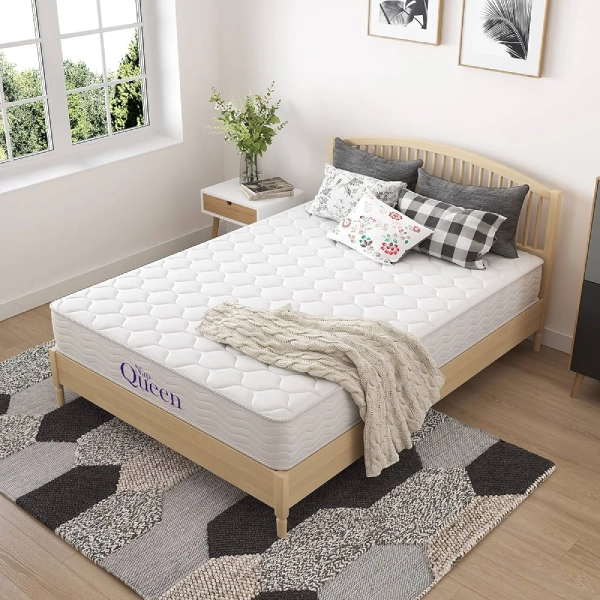
The Victoria 12-inch is described as a gel-infused memory foam and pocket spring hybrid, with a deeply quilted cover and edge-to-edge coils. Firmness is stated as medium.
The Elizabeth 14-inch is all-foam, described as three foam layers with a gel-infused top, ventilation holes and a high-density base, with a removable zip cover that can be washed. Firmness is stated as medium-firm.
Both carry CertiPUR-US certification on the foams, which is a real third-party certification covering emissions and content, and more than many sub-$200 mattresses publish.
A washable removable cover on the Elizabeth is a genuinely practical feature at this price and one that mattresses three times dearer often skip.
What is not published is the layer-by-layer breakdown. Neither listing gave the thickness of the comfort layer, which is the number that decides how a hybrid actually feels. On a 12-inch bed, a two-inch comfort layer and a four-inch one are completely different mattresses.
The review record
The Victoria 12-inch listing showed 4.2 out of 5 from about 23,700 ratings. The Elizabeth 14-inch showed 4.3 from 1,964 ratings and 1,400 written reviews. Both are solid numbers.
Twenty-three thousand ratings is a large base, and a 4.2 across that volume is a meaningful signal in a way that a 4.8 from forty reviews is not. It does not tell you how the bed holds up in year four, because very few people come back to update a retailer rating, and that is exactly the period the two-year limited warranty has already closed on.
One practical note from the listings themselves. The Elizabeth 14-inch page we read showed no price and no availability for shipping, pickup or delivery, so the range appears to be stocked in batches rather than continuously. Availability of a specific model, height and size is worth confirming before you set your heart on one.
Who should buy one
Somebody furnishing a guest room, a child's room, a first apartment or a rental, where a bed needs to be acceptable rather than excellent and the budget is the binding constraint. At around $5 per square foot in the larger sizes, with CertiPUR-US foams and a large positive review base, this is a reasonable answer to that problem.
It suits a primary bed much less well. The two-year limited warranty and the absence of a published sleep trial together mean you carry the risk of years three onward yourself. For a bed you will sleep on nightly for a decade, that is where the real cost of a cheap mattress shows up.
Anyone choosing a mattress because of back pain or any other medical reason should take that question to a clinician. A firmness label on a retailer listing is not a clinical recommendation, and nothing here should be read as one.
The verdict
As a budget bed this does what it says. The CertiPUR-US certification and a washable cover on the foam model are better than the price suggests. The arithmetic is where the useful advice sits.
Two numbers close this NapQueen mattress review. Buy the largest size your room allows, because the Twin XL costs $6.54 per square foot against the King's $5.02, and the small sizes are quietly the worst value in the range. And treat the 2 Years Limited Warranty as the real specification it is, because it expires long before a foam mattress starts to sag, which leaves you covered for the problems that rarely happen and uncovered for the one that does.